02
Industrial Automation
Engineered control infrastructure for industrial processes, equipment and electrical systems.

Expertise · 01
Integrated control for buildings where comfort, energy and operational visibility need to work as one.
Building Management Systems and building automation engineering for commercial and technical projects across Dubai and the wider UAE.
Explore the systemsBuilding Intelligence
Confido approaches Building Intelligence as an engineering and systems-integration discipline for UAE projects—bringing BMS design, programming, integration, commissioning and monitoring into one building-control context.
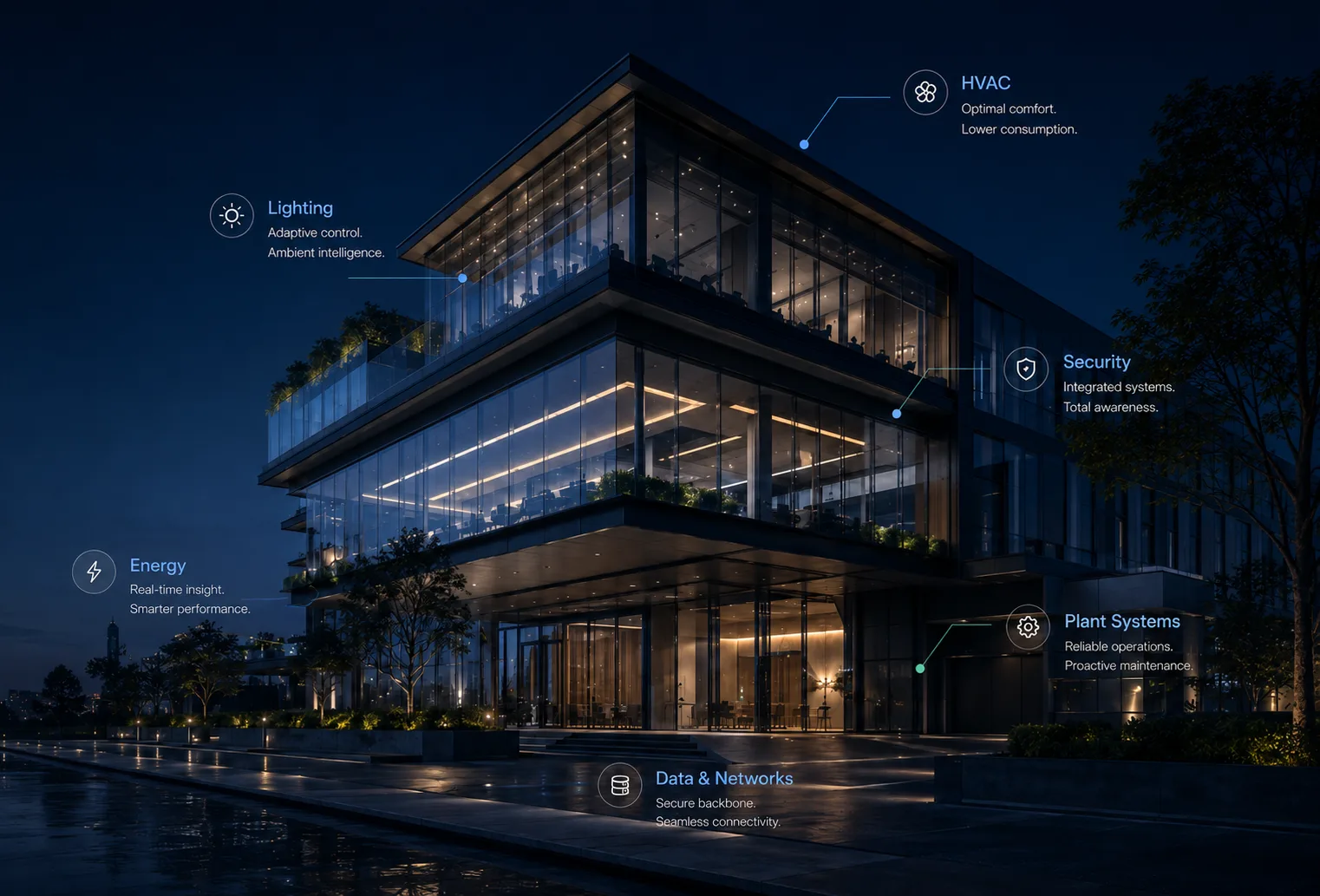
Integrated environment
A coordinated control environment considers how individual building systems relate to control intent, supervisory visibility and useful operating information.
01
Local controls translate defined operating intent into the day-to-day operation of each building system.
02
BMS, HVAC, lighting, energy and room controls are engineered in relation to the wider building environment.
03
Relevant operating information is organised to give operators a clearer view of system condition and operation.
Systems
01
Engineering scope
Open building control from field systems to supervisory operation.
Confido engineers Building Management Systems that connect HVAC plant, terminal equipment, metering, lighting, electrical services and compatible third-party systems within a coordinated operating environment.
For current Honeywell-based architectures, systems can be engineered around the Honeywell Optimizer Suite together with Niagara-based supervisory technology. The control architecture is developed around the requirements of the building: plant control, distributed I/O, communications, alarms, schedules, trends, graphics and integration are structured so operators have a clear view of how the facility is performing.
The objective is not simply to place multiple systems on one screen. Confido engineers the point structure, control sequences, communications and supervisory hierarchy so that information reaches the operator in a useful and maintainable form.
Existing CentraLine, EAGLEHAWK and other legacy BMS environments can be assessed for phased modernization. Depending on the condition and compatibility of the installed infrastructure, this may include controller replacement, supervisory migration, network modernization and integration of suitable existing field devices into the updated architecture.
02
Engineering scope
Control strategies engineered around the mechanical system.
Confido designs HVAC control systems around the actual operating requirements of the mechanical plant—from individual air-handling equipment to coordinated chilled-water systems.
Control sequences can coordinate chillers, pumps, cooling towers, AHUs, FAHUs, FCUs, VAV applications, ventilation equipment, sensors, actuators and variable-frequency drives within the wider Building Management System.
For Honeywell-based projects, the Optimizer control architecture and associated I/O technologies can provide the plant-control layer, while Niagara-based supervision provides centralized monitoring, alarming, scheduling and operational visibility. The final controller and field-device selection is determined by the project requirements and locally available product range.
For retrofit projects, Confido can assess existing panels, controllers, sensors, actuators, VFD interfaces and communication networks before defining the modernization approach.
03
Engineering scope
KNX and DALI lighting integrated with the wider building environment.
Confido engineers lighting-control systems for commercial, hospitality, residential and technical environments using open building-control technologies including KNX and DALI / DALI-2.
Honeywell DALI64 can provide addressable DALI-2 lighting control for luminaires, sensors, switches, groups and scenes, while KNX-based room controls can provide user interaction for lighting, shading and temperature functions.
Lighting can be coordinated with occupancy status, daylight conditions, schedules, scenes and building operating modes. Where required, the lighting system can also exchange information with the BMS so that lighting is part of the wider operating strategy rather than an isolated electrical subsystem.
04
Engineering scope
Turn electrical measurements into usable operational information.
Confido develops energy and electrical-monitoring architectures that provide structured visibility into consumption, demand and power-system performance across buildings and infrastructure.
Using Janitza measurement technology together with GridVis® software, electrical data can be collected from main incomers, distribution systems and selected loads, then organized into dashboards, trends, alarms and reports for engineering and facility-management teams.
Depending on the selected metering architecture, the system can extend beyond basic energy consumption to provide visibility into electrical parameters, loading, power quality, harmonics and residual-current conditions.
The purpose is to provide engineers and operators with reliable data for investigation, comparison and operational decision-making—not simply to collect meter readings.
Measurement devices are selected according to the monitoring requirement. Architectures may include modular energy analyzers, multifunction meters or Class A power-quality analyzers where the application requires them.
05
Engineering scope
One coordinated living environment—not a collection of isolated smart devices.
Confido designs GRMS and home-automation systems around KNX and other open integration technologies, bringing lighting, climate, shading, access, intercom and compatible connected devices into a coordinated control environment.
The architecture is selected according to the project rather than forcing every function into a single proprietary ecosystem. Field-level KNX control, visualization platforms, HVAC gateways, IP communication and compatible smart-device technologies can be combined so that each subsystem performs its intended role while presenting a coherent experience to the user.
01
Eelectron KNX technologies can provide the room-level control layer for residential and hospitality applications, combining lighting, climate, shading, scenes, occupancy and room-status functions within a common KNX architecture.
Current Eelectron platforms such as OL-U and the 9025 family provide contemporary room interfaces, thermostatic control and configurable KNX functions. Hospitality applications can also incorporate functions such as Do Not Disturb, Make Up Room, presence logic and compatible access-control interfaces.
02
Inspinia touch panels, servers and integration interfaces can provide a central user layer for lighting, climate, shading and connected room functions.
Depending on the project architecture, Inspinia systems can interface with KNX, Modbus, selected VRF systems, Zigbee and other supported technologies, allowing room functions to be presented through a consistent touchscreen and connected control environment.
03
Where air-conditioning systems use manufacturer-specific communication networks, Confido can integrate compatible VRF and AC equipment into KNX, BMS and home-automation environments using Intesis HVAC gateways.
The gateway is selected against the actual air-conditioning manufacturer, indoor-unit architecture, system capacity and required building protocol. This allows relevant operating commands, status information and alarms to be exposed to the wider automation environment without replacing the native HVAC controls.
Current Intesis technology includes the 700 Series / 700 Series Air platform and Intesis MAPS configuration environment, subject to the required HVAC manufacturer and protocol combination.
04
FERMAX IP video-intercom technologies can extend the automation environment to visitor communication, door entry and compatible access functions.
The FERMAX MEET IP platform can support video communication, mobile call diversion and integration with compatible CCTV, access-control and home-automation systems, allowing the intercom environment to participate in the wider residential technology architecture where the project requires it.
Compatible smart locks and connected devices can also be integrated where the selected equipment provides a documented automation interface. For newer connected-home ecosystems, Matter-ready integration may be incorporated where supported by the selected device and automation platform.
Open integration
Building intelligence depends on reliable interfaces between systems. Confido selects communication protocols according to the equipment, project requirements and required level of integration rather than forcing every subsystem onto one technology.
Protocol and interface selection is project-specific and depends on the capabilities of the connected equipment.
Engineering approach
01
Define control intent, system relationships and integration boundaries.
02
Develop control logic, supervision and interfaces as a coherent environment.
03
Verify operation and relationships before systems enter service.
04
Support operation after commissioning through preventive maintenance, troubleshooting, condition review and planned retrofit or upgrade work.
Engineering beyond commissioning
Building-control systems continue to evolve after commissioning. Confido supports existing installations through technical assessment, troubleshooting, preventive-maintenance activities, control-system upgrades and staged modernization.
Where viable, retrofit strategies can retain suitable field infrastructure while modernizing controllers, supervisory platforms, communications and user interfaces.
Confido expertise
02
Engineered control infrastructure for industrial processes, equipment and electrical systems.
03
Connections between control systems, remote operations and useful data layers.
Building Intelligence